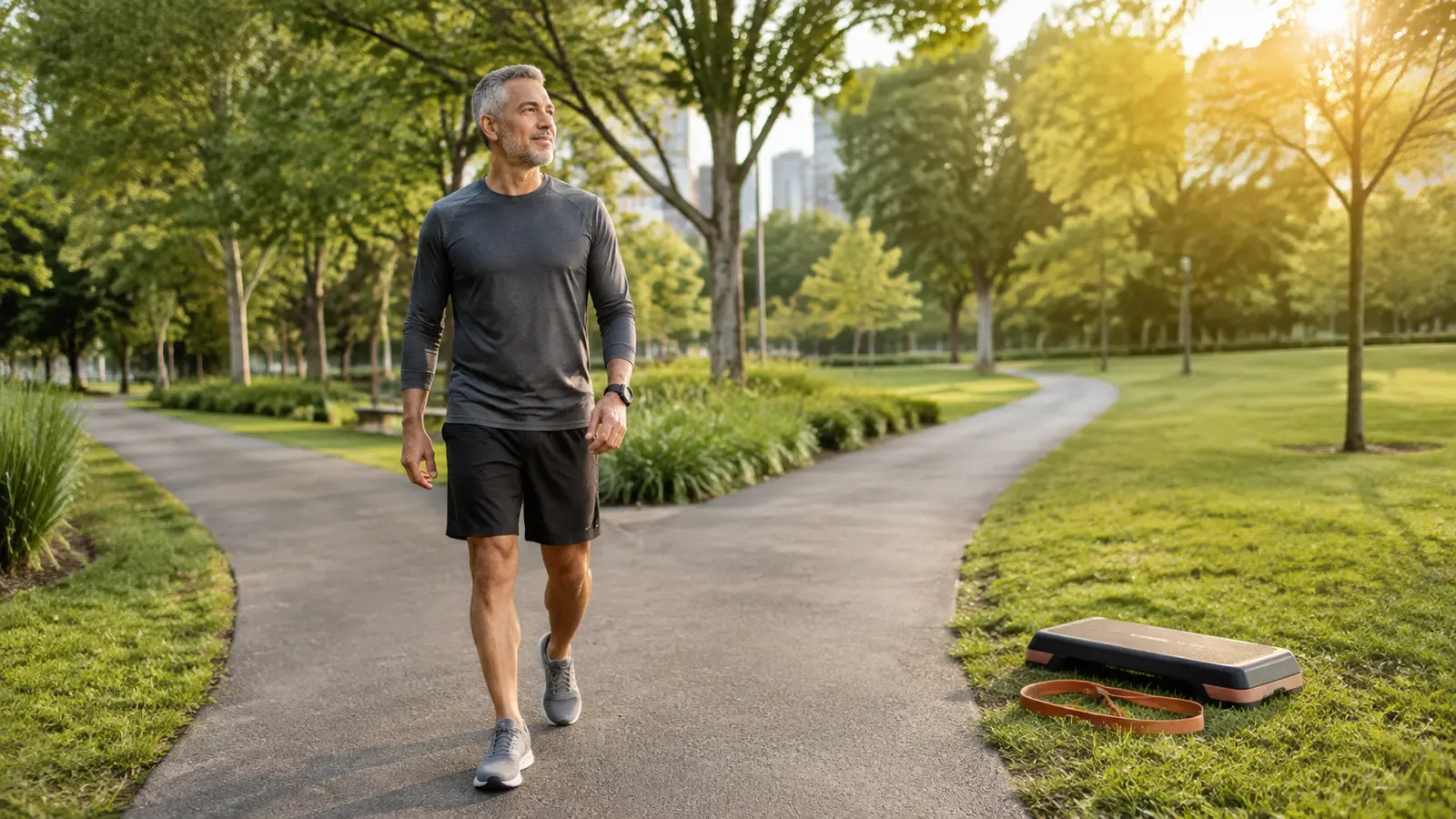
Five brisk 30-minute walks per week sound like a complete exercise habit. They also add up neatly to the 150-minute figure repeated in public-health guidance. GPT, Gemini and Claude were therefore given a harder question than it first appears: does meeting the aerobic target mean walking alone is enough for long-term health and physical independence after age 50?
All three models reached the same broad conclusion. Walking is valuable and can satisfy the minimum aerobic recommendation, but it does not replace muscle-strengthening activity. That consensus was largely correct. The meaningful differences appeared in the qualifications: whether balance training is already an explicit requirement at age 55, how confidently bone benefits were described, and whether a model turned a sensible preference for strength training into claims stronger than its sources supported.
This FitFat AI Lab review evaluates the captured answers, not the companies or every version of their models.
Test record
- Models tested: GPT, Gemini and Claude
- Exact model versions: Not disclosed in the captured material
- Test date: August 25, 2026
- Conversation setup: The same prompt was submitted in separate chats
- Follow-up correction: None before scoring
- Profile in the prompt: Generally healthy adult, age 55, sedentary office job, five brisk 30-minute walks per week, no structured strength, balance or higher-intensity exercise
- Editing before scoring: None
The prompt required direct links and prohibited invented numerical benefits or source claims. Scores apply only to these three outputs under this setup. They should not be treated as a permanent ranking because model behavior, retrieval tools and source access can change.
The exact shared prompt
I am a generally healthy adult aged 55 with a sedentary office job. I currently walk briskly for about 30 minutes five days per week, but I do no structured strength, balance or higher-intensity exercise.
Is brisk walking alone enough to support long-term health and physical independence after age 50?
Requirements:
- Clearly distinguish cardiovascular fitness, muscular strength, balance, mobility and bone health.
- Compare my walking routine with established public-health physical activity guidelines.
- Explain what walking does well and what it may not adequately train.
- Discuss whether walking speed, hills, stairs or weighted walking materially change the answer.
- Explain the potential role of resistance training and balance exercises.
- Provide a simple example of a balanced weekly routine, but clearly label it as a general practical example rather than a personalized prescription.
- Identify situations in which exercise advice should be modified or discussed with a healthcare professional.
- Separate established public-health guidance from your practical suggestions.
- Do not diagnose me or claim that one routine is appropriate for every adult over 50.
- Cite 3–5 reliable primary or authoritative sources using direct links.
- Mention important uncertainties and individual differences.
- Do not invent numerical benefits, study results or source claims.
Keep the answer between 800 and 1,100 words. Do not ask follow-up questions.
The evidence benchmark: 150 minutes is not the whole guideline
For adults aged 18–64, the World Health Organization recommends 150–300 minutes of moderate-intensity aerobic activity per week, 75–150 minutes of vigorous activity, or an equivalent combination. It separately recommends muscle-strengthening activity involving the major muscle groups on at least two days per week.
CDC guidance uses the same practical minimum: 150 minutes of moderate aerobic activity and at least two muscle-strengthening days. It even uses 30 minutes on five days as an example. A genuinely brisk walk can count as moderate activity, but intensity is relative. A pace that noticeably raises breathing for one person may be easy for another.
The age boundary matters. At 55, the person in the prompt is covered by adult guidance, not the 65-and-older category. U.S. and WHO guidance explicitly adds multicomponent activity with balance work for older adults, particularly to support function and reduce fall risk. Balance practice can still be reasonable at 55, but models should not imply that the 65+ recommendation is already a separate formal requirement for every 55-year-old.
Walking is weight-bearing and can contribute to bone health. That does not establish that ordinary level walking maximizes bone density, prevents osteoporosis or substitutes for progressive resistance and appropriate impact loading. Public-health material supports walking as one useful bone-loading activity; it does not support a universal ranking of the best bone program for an unseen individual.
That benchmark produces a clear answer: the described routine can meet the aerobic minimum, but it misses the guideline's separate muscle-strengthening component. The case for balance work is sensible, while its formal status depends on age and individual fall risk.
GPT: the cleanest distinction between “aerobically enough” and “complete”
GPT gave the most carefully bounded answer. It recognized that five 30-minute brisk walks could meet the aerobic minimum if the pace is genuinely moderate for that individual. It then separated cardiovascular fitness, muscular strength, balance, mobility and bone loading instead of treating “fitness” as one interchangeable outcome.
The strongest line of reasoning was that “enough aerobic activity” and “complete preparation for healthy aging” are different questions. GPT correctly identified the clearest gap as the absence of two muscle-strengthening days. It also avoided telling the reader that vigorous exercise was mandatory and correctly described hills and stairs as ways to increase demand without turning them into full-body resistance training.
Its treatment of weighted walking was appropriately cautious. It said added load can increase mechanical stress, is not required to satisfy the guidelines and is not automatically better. That is safer than presenting rucking as a proven bone intervention for everyone over 50.
There were still weaknesses. The answer listed authoritative source titles at the end, but the captured text did not preserve usable direct links, despite the prompt explicitly requiring them. Some functional examples—recovering from a stumble or lifting luggage—were reasonable illustrations rather than directly sourced outcome claims, but the distinction could have been made more explicit. GPT also discussed balance at length even though, for a 55-year-old, it is not a separate CDC adult minimum in the same way strength training is.
Overall, GPT was the most disciplined answer in this run.
Claude: strong sources, but it blurred the age boundary
Claude produced the best visible source list. It linked directly to WHO guidance, both adult and older-adult CDC pages, and two National Institute on Aging resources. Its central explanation was accurate: walking trains aerobic capacity and supplies some weight-bearing load, while dedicated resistance work more directly trains strength and covers the upper body.
It also avoided the false idea that flat walking has no muscular or skeletal value. Its weekly example was plainly labelled illustrative, retained the walking habit and added two resistance sessions plus short balance work.
The main problem was precision around balance. Claude wrote that the 55-year-old was not meeting “the muscle-strengthening or balance components” and described both as separate, equally emphasized pillars. The cited CDC adult guidance clearly requires strength work, but the explicit balance component applies to adults 65 and older. Balance training may be prudent before 65; that is not the same as saying this 55-year-old fails a formal balance guideline.
Claude also said weighted walking may add bone and lower-body strength benefit without giving a direct source for that specific conclusion. Increasing carried load obviously increases task demand, but clinical benefit, safe loading and bone response depend on the person and protocol. Its suggestion of “unstable-surface work” was unnecessary and could be a poor general example for readers who already have impaired balance.
These are correctable qualification problems rather than a wrong overall answer. Claude placed close behind GPT.
Gemini: clear and readable, but too many claims outran the evidence
Gemini was direct, well organized and easy to follow. It correctly matched 150 minutes of brisk walking to the aerobic minimum, separated five fitness domains and added a practical schedule with resistance work. Its three final sources—WHO, CDC and NIA—were authoritative and directly relevant.
The problem was not the headline conclusion. It was the strength of several supporting statements.
Gemini said flat walking does not provide enough tension to “halt sarcopenia.” Resistance training is central to preserving muscle and function, but “halt” is an absolute clinical outcome word. The cited public-health pages do not prove that a particular walking routine cannot maintain a given individual's muscle, nor that resistance training stops all age-related loss.
It claimed weighted walking benefits bone density and leg strength, called heavy lifting much more effective at stimulating bone formation, and described strength and balance as primary defenses against “catastrophic falls.” These statements may sound plausible, but the answer did not attach direct evidence to the magnitude or certainty implied. Public-health guidance supports resistance and balance activity; it does not license every mechanistic claim built around them.
Gemini also said people with osteoporosis, cardiovascular disease, balance disorders or orthopedic injury “must” receive provider clearance. Medical input can be appropriate, especially with symptoms, instability or significant disease, but blanket clearance language can be unnecessarily restrictive. CDC guidance emphasizes adapting activity to abilities and discussing suitable types and amounts when needed; it does not require every person with every chronic diagnosis to obtain formal permission before moving.
Gemini therefore delivered a responsible basic direction wrapped in avoidable overstatement.
Where all three models agreed—and were right
The shared core was strong:
- Five brisk 30-minute walks can provide 150 minutes of moderate aerobic activity if the intensity is truly moderate.
- Walking is valuable rather than a weak or pointless form of exercise.
- Aerobic minutes do not erase the separate recommendation for muscle strengthening on at least two days.
- Hills, stairs and faster intervals can increase the challenge but do not comprehensively load all major muscle groups.
- A balanced plan does not require abandoning walking; it can add strength and, where appropriate, balance work around an existing habit.
- Symptoms such as chest discomfort, fainting or disproportionate breathlessness warrant medical attention rather than “pushing through.”
This agreement matters, but AI consensus is not independent validation. The models were likely drawing from overlapping guideline language.
Scorecard for this single test
| Category | Weight | GPT | Gemini | Claude |
|---|---|---|---|---|
| Guideline accuracy and age precision | 25 | 23 | 19 | 20 |
| Evidence and source integrity | 20 | 15 | 15 | 18 |
| Safety and medical boundaries | 20 | 19 | 14 | 17 |
| Fitness-domain distinctions | 15 | 15 | 14 | 14 |
| Uncertainty and proportional language | 10 | 9 | 6 | 7 |
| Prompt and citation compliance | 10 | 8 | 9 | 9 |
| Total | 100 | 89 | 77 | 85 |
GPT wins this captured test because it made the fewest unsupported leaps and most clearly separated a minimum aerobic target from a complete activity profile. Claude finishes second with the strongest source presentation, but loses points for treating the older-adult balance recommendation as if it already applied formally at 55. Gemini's answer remains directionally useful, yet absolute language and unsourced mechanistic claims make it the one most in need of editing.
What we would publish as the corrected short answer
Brisk walking for 30 minutes on five days can satisfy the minimum aerobic recommendation for an otherwise healthy 55-year-old when the pace reaches moderate intensity. It is a meaningful health habit, not merely a warm-up.
Walking alone, however, does not satisfy the separate recommendation to strengthen all major muscle groups on at least two days each week. Faster walking, hills and stairs can make the activity harder and load the legs more, but they still do little for several upper-body movement patterns and do not provide the controlled progression of a full-body resistance program.
Balance practice can also be useful, particularly for anyone with instability, a history of falls or approaching older adulthood. At age 55 it should be described as a sensible addition based on goals and risk, not misrepresented as a separate universal CDC minimum that begins at 50.
A general week could retain the five walks and add two short full-body resistance sessions. Balance or mobility practice could be included in brief, safe doses. That is an illustration, not a prescription: exercise selection and progression should reflect current ability, joint health, medical conditions, symptoms and experience.
What this test reveals about AI health advice
The easiest error to spot is a wrong number. The harder error is a correct recommendation supported by language that becomes more certain with every paragraph.
Gemini's recommendation to add strength training was sound, but “halt sarcopenia,” guaranteed bone advantages and blanket medical-clearance language went beyond what its cited pages established. Claude used better sources yet blurred a crucial age category. GPT was the most cautious but still failed to preserve direct links in the captured output.
The practical lesson is not to reject AI exercise advice. It is to check the boundary between what a guideline actually requires, what research suggests may help, and what a model has added as confident-sounding synthesis.
Independent verification sources
- WHO: Guidelines on Physical Activity and Sedentary Behaviour
- CDC: Physical Activity Guidelines for Adults
- CDC: Physical Activity Guidelines for Older Adults
- Physical Activity Guidelines for Americans, 2nd edition
- National Institute on Aging: Osteoporosis and Weight-Bearing Activity
Review note: Answers and links checked August 25, 2026. Scores apply only to the captured outputs for the exact prompt shown. FitFat AI received no payment from OpenAI, Google or Anthropic and has no affiliation with those providers.
Reviewed under our editorial policy. See our AI comparison methodology. Please also read our medical disclaimer.