The fitness industry usually presents strength as a look: thicker arms, a leaner waist, more plates on a bar. After 50, that framing becomes a distraction. The strength that matters most is the capacity to keep doing ordinary things without turning each one into a negotiation.
Can you rise from a chair with control? Carry shopping from the car? Put a suitcase on a low shelf? Catch your balance when a step is not where you expected it? Get down to the floor and return using a route you trust?
Those are not bodybuilding questions. They are capability questions.
Low strength is associated with poorer mobility, greater difficulty with activities of daily living and higher health risk in population studies. That does not mean a handgrip score or chair-rise time diagnoses your future. Association is not destiny, and a home test is not a medical examination. It means strength deserves a place beside walking, sleep and nutrition in an honest healthy-aging plan.
FitFatAI calls this the Capability Reserve: the gap between what daily life usually asks of you and what you can safely do on a good, well-rested day. Training is not about proving that you are young. It is about keeping that gap from shrinking unnoticed.
Muscle size, strength and power are not the same thing
These terms are often mixed together.
- Muscle mass is the amount of muscle tissue.
- Strength is the force you can produce.
- Power is how quickly you can produce useful force.
- Function is whether that capacity transfers to a real task.
They overlap, but none perfectly represents the others. Someone can have modest-looking muscles and still be strong for their size. Another person may lift a heavy weight slowly yet struggle to produce force quickly enough to recover balance. Body weight, pain, technique, confidence, vision, medication and the environment also affect performance.
That is why the mirror is a poor health dashboard. Even a bathroom scale that estimates “muscle percentage” cannot tell you whether you can control a descent into a chair or carry an uneven load up a step.
The five-part Capability Stack
Instead of chasing one heroic lift, track five patterns that appear repeatedly in adult life.
1. Rise
Standing from a chair uses lower-body strength, coordination and balance. The 30-second chair-stand test has been studied as a practical measure of lower-body strength in community-dwelling older adults, but published reference values are not a pass/fail verdict for an individual.
For home tracking, use the same firm chair, footwear and hand-support rule each time. Record a small number of smooth repetitions or simply note whether the task feels stable. Stop for pain, dizziness, chest pressure or unusual breathlessness. The useful signal is the trend under consistent conditions—not beating a stranger's number.
2. Hinge and lift
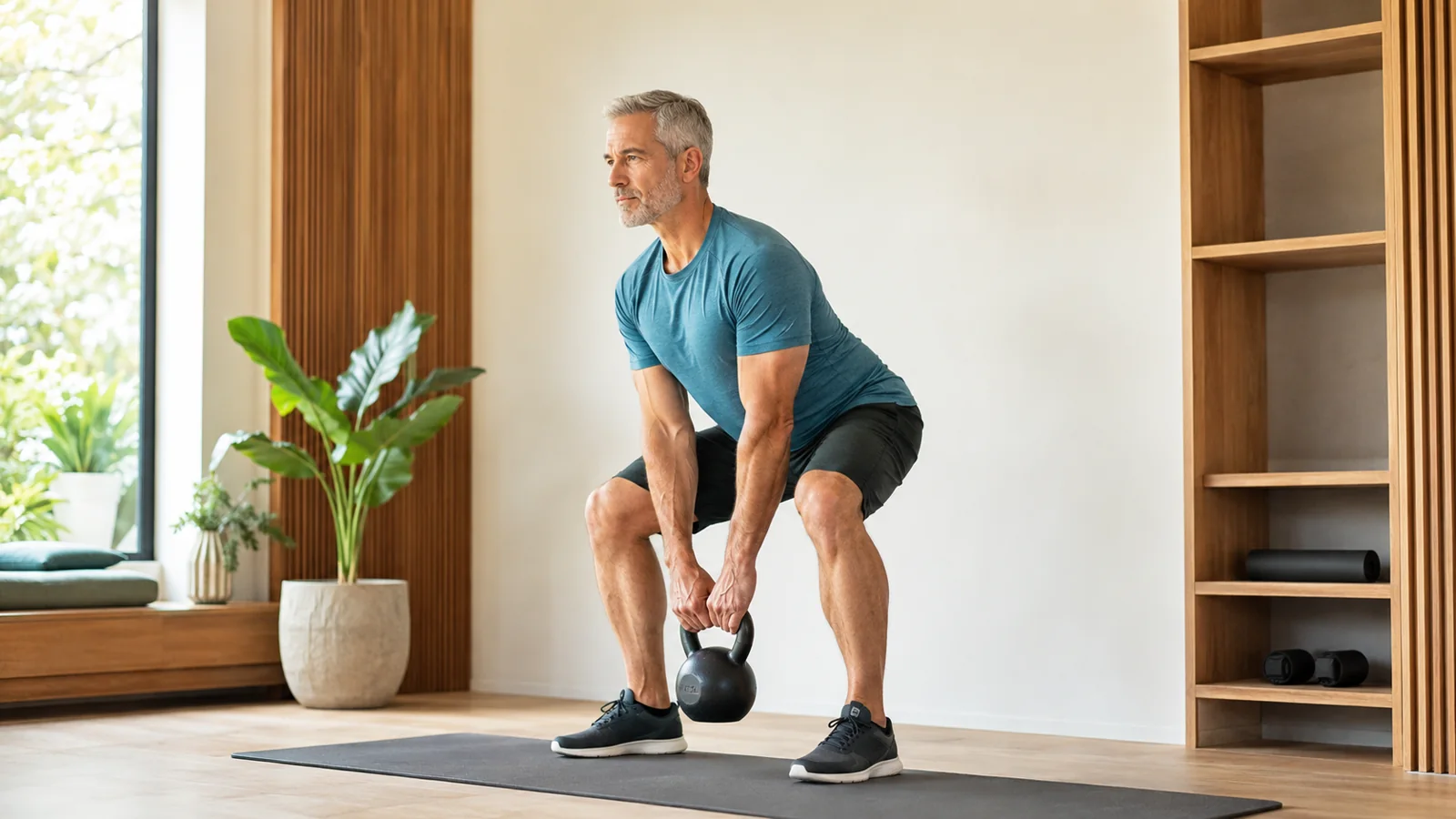
Life asks you to pick up laundry, garden tools, boxes and grandchildren. A hinge pattern distributes that work through the hips and legs instead of turning every lift into a rounded-back reach.
The training version might be a kettlebell deadlift from an elevated surface, a hip hinge to a wall or a light object lifted from a sturdy step. The goal is repeatable control: the load stays close, the feet remain stable and the next repetition looks like the first.
3. Carry
Grip strength is widely used in research because it is quick to measure and is associated with overall strength and later health outcomes. But grip is not magic and it is not the whole body.
A practical carry includes the grip, trunk, hips, walking pattern and the ability to breathe while moving. Carry two manageable bags for a short, clear route. Progress by improving posture or distance before making the bags much heavier. Never use a load that you could not set down calmly.
4. Push and pull
Opening a heavy door, moving a chair and steadying yourself all involve upper-body force. A wall push-up, supported cable or resistance-band row can train these patterns without demanding floor exercise.
The standard is not maximum load. It is whether the shoulder, elbow and wrist can share the work comfortably through a controlled range. Persistent joint pain is a reason to change the setup or seek assessment, not to prove toughness.
5. Stabilize and step
Strength becomes useful when the body can organize it while standing, turning and stepping. The U.S. Physical Activity Guidelines therefore recommend that older adults combine aerobic, muscle-strengthening and balance activity rather than treating them as competing options.
A supported step-up, split stance or controlled change of direction can expose a missing link that a seated machine does not. Keep a stable support within reach. Balance practice should create attention, not panic.
The FitFatAI rule: test the task, train the pattern
A test is only a snapshot. Repeating a maximum-effort test every week mostly measures your willingness to test.
Use this sequence instead:
- Choose one ordinary task. For example, five calm chair rises or carrying two shopping bags along a fixed hallway.
- Define the conditions. Same chair, route, footwear, support and approximate time of day.
- Record quality before quantity. Pain, balance, breathing and control matter before repetitions or kilograms.
- Train the underlying pattern for four to six weeks. Do not test it hard every session.
- Recheck under the original conditions. Look for a clearer, steadier or easier task—not just a bigger number.
This creates information you can use. A random personal best creates a story.
A minimum effective strength week
Public-health guidance recommends muscle-strengthening work for all major muscle groups on at least two days each week. That is a foundation, not a complete prescription. A simple full-body session can be built around the Capability Stack:
- a chair rise or squat to a comfortable target;
- a supported hinge or deadlift pattern;
- a wall, counter or machine push;
- a band, cable or machine pull;
- a short carry or supported step exercise.
Begin with a version you could perform for a few more repetitions than you actually do. One or two controlled sets can be enough for a new or returning trainee. Over time, progress only one variable at once: repetitions, range, resistance, sets or complexity.
Effort should eventually be meaningful, because endlessly lifting something that never challenges you gives the body little reason to adapt. But “meaningful” does not mean grinding, holding your breath or losing the movement. The last repetitions should look recognizably like the first.
Recovery is part of the programme. Strength is built between sessions when training is supported by adequate food, protein, sleep and time. Soreness is not a score, and exhaustion is not proof of effectiveness.
What counts as progress after 50?
Progress may look less dramatic than a transformation photo and matter far more:
- using the same hand support with less pulling;
- lowering into a chair quietly instead of dropping;
- carrying the same bags without leaning;
- using a lower starting surface for a safe lift;
- taking stairs with less hesitation;
- completing a session without joint symptoms lasting into the next day;
- recovering confidence after a period of inactivity.
The Capability Reserve can also grow when the task stays the same but costs less effort. That is not “no progress.” It is the exact adaptation daily life needs.
Do not turn screening into diagnosis
Grip dynamometers, chair-stand times, walking speed and short physical-performance batteries are useful in research and clinical settings. Their interpretation depends on age, sex, body size, technique, equipment, health history and the purpose of testing. Online cut-off tables strip away that context.
A low or declining result can be a prompt for a conversation, not a label. New weakness, repeated falls, unexplained weight loss, severe fatigue, sudden loss of function, persistent pain, numbness, chest symptoms or breathlessness out of proportion to effort deserve professional assessment. Training harder is not the correct response to every decline.
People with recent surgery, unstable heart or lung symptoms, poorly controlled blood pressure, acute injury, significant osteoporosis or fracture history, neurological conditions, or clinician-imposed restrictions should obtain individual guidance before starting or changing resistance exercise.
Why this is a health metric
Strength is not a vital sign in the same way as temperature or blood pressure. The phrase “health metric” here means something more practical: a capacity worth observing because it supports independence and because decline can otherwise remain invisible until an ordinary task becomes difficult.
Research consistently links lower grip strength and poorer physical performance with worse outcomes. Yet those studies do not prove that increasing one test score directly prevents every associated outcome. Strength is one part of a wider system that includes disease, nutrition, activity, cognition, environment and social support.
The honest conclusion is still powerful. Adults are advised to strengthen major muscle groups at least twice weekly, and older adults benefit from combining that work with aerobic and balance activity. The reason is not to look like a fitness model. It is to preserve options.
Train so the floor is still accessible. Train so a bag remains a bag, not an obstacle. Train so that when life asks for more than usual, you have some capacity in reserve.
Sources
- U.S. Department of Health and Human Services: Physical Activity Guidelines for Americans, 2nd edition
- CDC: Physical Activity Guidelines for Older Adults
- PubMed: Handgrip Strength, Function, and Mortality in Older Adults
- PubMed: A 30-Second Chair-Stand Test as a Measure of Lower-Body Strength
- PubMed: Physical Performance Measures as Predictors of Mortality
Review note: This article provides general education, not a diagnosis, exercise prescription or substitute for medical or physiotherapy advice. Reviewed August 24, 2026.
Reviewed under our editorial policy. Please also read our medical disclaimer.