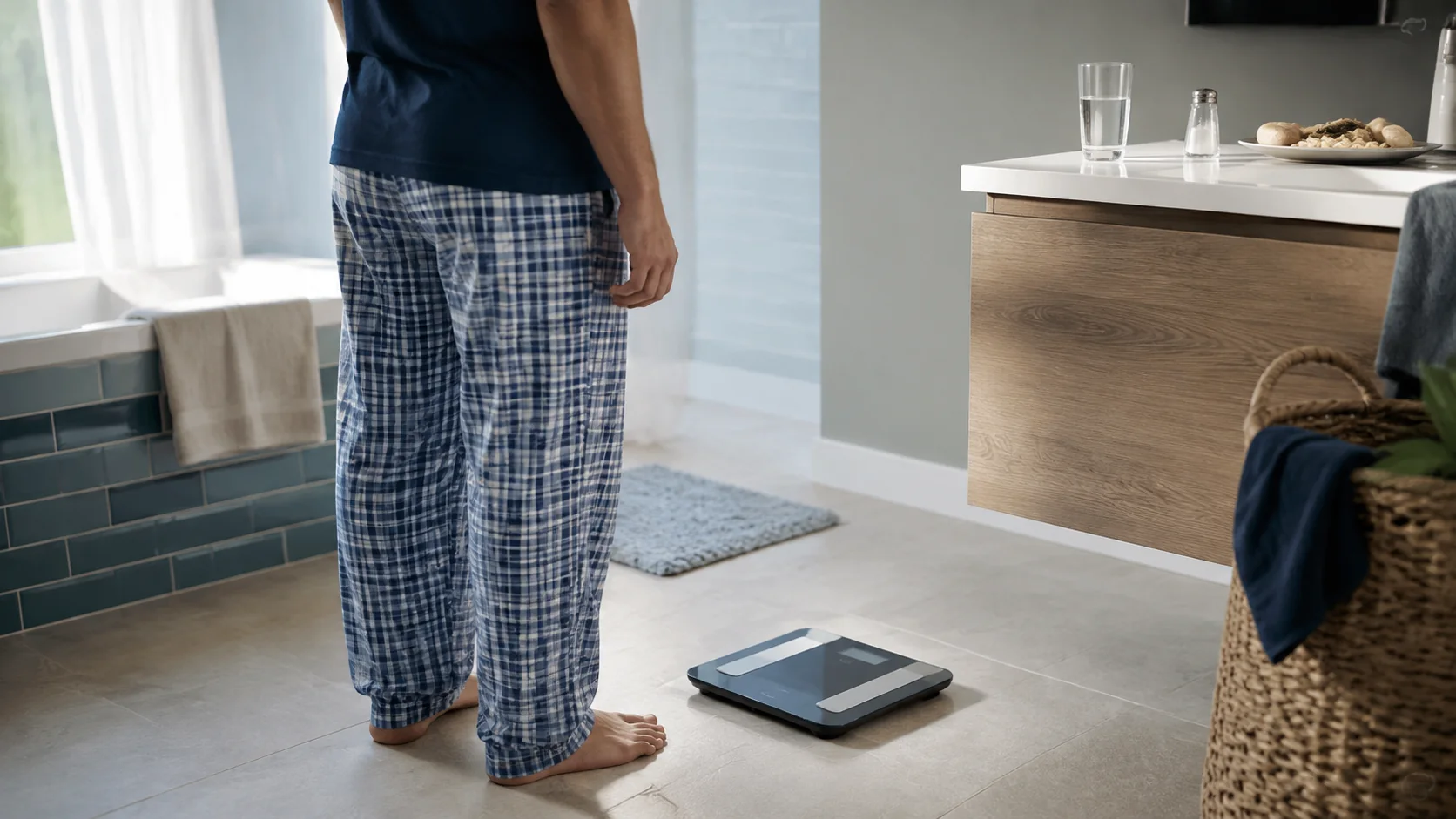
You step on the scale after a restaurant meal and the number is suddenly higher. The immediate story writes itself: yesterday ruined the week. But a scale does not measure body fat. It measures the total force of everything in and on the body at that moment—including water, stored carbohydrate, food moving through the digestive tract and, yes, fat and other tissue.
That distinction is not an excuse to ignore a genuine upward trend. It is a reason to stop asking a one-day measurement to answer a long-term question.
This guide explains the most common short-term causes, what the number can and cannot tell you, and when rapid gain deserves medical attention rather than another diet adjustment.
First: weight change and fat change are not synonyms
Body mass is a mixed signal. A household scale cannot separate adipose tissue from fluid, glycogen or gut contents. Even bioelectrical-impedance scales only estimate body composition, and their readings can be affected by hydration and measurement conditions.
Fat gain requires a sustained surplus of energy stored in tissue. The familiar calorie-per-pound rules are rough models, not laws that let us diagnose yesterday's change from today's scale. Human energy expenditure adapts, and the composition of weight change varies. The safer conclusion is narrower: a sharp overnight movement is too fast and too nonspecific to be interpreted as an equivalent change in body fat.
Researchers using connected scales have observed recurring weekly and holiday rhythms, with weight commonly rising on some days and falling on others. That pattern is precisely why a trend can be informative while an isolated high reading is often noisy.
1. Sodium can hold extra water
A salty dinner is one of the most ordinary explanations for a higher morning weight. Sodium is essential, but changes in sodium intake affect fluid balance. The American Heart Association notes that excess sodium can increase water retention and contribute to puffiness, bloating and weight gain.
This does not mean every salty meal produces the same response. Kidney function, medications, usual sodium intake, carbohydrate intake, hormonal state, sweating and fluid intake all influence what happens next. Nor does it mean a person should try to “flush out” the number by forcing large amounts of water. For most generally healthy adults, returning to their normal eating and drinking pattern is more sensible than reacting aggressively to one measurement.
A restaurant or takeaway meal can also combine several scale-moving variables: more sodium, more carbohydrate, more food volume, a later eating time and sometimes alcohol. The next-morning number cannot tell you which component contributed what.
2. Carbohydrate storage also stores water
The body stores carbohydrate as glycogen, primarily in liver and muscle. Glycogen is stored with water. The NIH-hosted Endotext chapter on dietary treatment of obesity explains that gains or losses of glycogen can therefore produce rapid shifts in body water, especially when carbohydrate intake changes substantially.
This helps explain two experiences that otherwise seem contradictory:
- weight may fall quickly during the first days of a lower-carbohydrate diet without representing the same amount of fat loss;
- weight may rebound after a higher-carbohydrate day without representing the same amount of fat gain.
Exercise adds another layer. A long or unusually hard session can reduce glycogen, while later carbohydrate intake restores it. Training can also change fluid distribution through sweating and recovery. The scale sees the combined result, not the separate processes.
None of this makes carbohydrate “bad” or scale changes meaningless. It means that glycogen-associated water is part of normal physiology and should not be mislabeled as instant fat.
3. Food and drink still have mass while the body processes them
The contents of a meal do not disappear when calories are logged. Food and fluid add physical mass before digestion, absorption and elimination have run their course. A larger, later or higher-fibre meal can therefore leave a different amount of material in the digestive tract the next morning.
Bowel habits matter too. Constipation, a change in meal timing or travel can alter gut contents without reflecting a meaningful change in body tissue. This is one reason comparing an evening measurement after dinner with a morning measurement after using the bathroom creates more confusion than useful information.
The practical implication is simple: standardize the conditions before trying to interpret small differences.
4. Hormonal shifts can change fluid balance
For people who menstruate, body weight can move across the menstrual cycle. The direction and size are not identical for everyone, and symptoms can vary from cycle to cycle. Fluid retention, appetite changes, bowel changes and different eating patterns may all contribute.
The useful comparison is often not “today versus yesterday,” but similar phases across multiple cycles. A recurring premenstrual rise that later resolves tells a different story from a multiweek upward trend.
Hormones are sometimes used online as a catch-all explanation for any frustrating result. That is not justified. A scale pattern alone cannot diagnose a thyroid, reproductive or adrenal disorder. Persistent unexplained change accompanied by other symptoms belongs in a clinical conversation, not a social-media diagnosis.
5. The measurement itself may have changed
Before interpreting physiology, check the measurement:
- Was the scale on the same hard, level surface?
- Was it the same time of day?
- Had you eaten, drunk, exercised or used the bathroom?
- Were you wearing different clothing?
- Was the scale moved, tilted or low on battery?
These are not trivial details when someone is reacting to small changes. The American Heart Association's heart-failure guidance recommends weighing at the same time each morning, before breakfast and after urinating. That advice is given in a clinical monitoring context, but the measurement principle is broadly useful: consistency reduces avoidable noise.
If your schedule makes mornings impractical, another repeatable time can still be useful. The key is comparing like with like.
A better way to read scale data
One number is a snapshot. A sequence is a signal.
A practical tracking method is to record measurements under similar conditions and focus on a rolling average or the direction across several weeks. A seven-day average is not a medical standard, but it is a useful way to soften day-to-day noise. Compare averages over time rather than treating the week's lowest number as the only “real” one and every rebound as failure.
Also annotate unusual days. A short note such as “restaurant meal,” “late flight,” “hard training,” “constipated” or “period started” can make an apparent mystery much easier to interpret later. Do not use the note to explain away every trend; use it to preserve context.
If weighing frequently damages your mood, drives compensatory restriction or makes eating and exercise more obsessive, more data may not be better data. Less frequent measurements, non-scale measures or support from a qualified professional may be more appropriate. The goal is to collect information, not to let the instrument set the emotional tone of the day.
What not to do after one high reading
A single increase is a poor basis for extreme action. Avoid trying to “correct” it with dehydration, punishing exercise, skipped meals, laxatives or unprescribed diuretics. These responses can create real harm while doing nothing to clarify the underlying trend.
Instead, keep the next step boring:
- Confirm the scale and measurement conditions.
- Return to your normal, sustainable routine.
- Record the number without assigning it a moral value.
- Watch what happens across the next several comparable measurements.
- Evaluate the longer trend, not the most alarming dot.
That approach is not complacency. It is better measurement.
When rapid weight gain is not just normal fluctuation
Sudden gain can sometimes reflect clinically important fluid retention. This is especially relevant for people with diagnosed heart, kidney or liver disease, or those taking medicines that affect fluid balance. Follow the monitoring thresholds and fluid or sodium instructions given by your own clinician; do not replace them with generic internet rules.
Seek prompt medical advice when rapid gain occurs with new or worsening swelling of the feet, ankles, legs or abdomen, unusual breathlessness, difficulty breathing when lying down, chest symptoms, faintness or a major reduction in urination. The NHS and American Heart Association both list sudden weight gain alongside swelling or breathlessness as a possible heart-failure warning sign.
Pregnancy, a new medication, a known endocrine condition, an eating disorder or unexplained persistent change also makes individualized advice more important. This article cannot determine the cause from a scale pattern.
The bottom line
An overnight scale increase is real as a measurement, but its meaning is not self-evident. Sodium-related water retention, glycogen-associated water, food and fluid still being processed, hormonal variation and inconsistent measurement conditions can all move total body mass without representing an equal change in body fat.
Use standardized measurements and read the trend across time. If the number rises once after an unusual meal, collect more information before changing the plan. If weight rises rapidly with swelling, breathlessness or other concerning symptoms—or if you have a condition that requires fluid monitoring—treat it as a health question and contact an appropriate healthcare professional.
The most useful scale is not the one that always shows a reassuring number. It is the one whose data you can interpret without pretending that every fluctuation has the same cause.
Sources
- American Heart Association: Effects of excess sodium
- Endotext: Dietary Treatment of Obesity
- Turicchi et al.: Weekly, seasonal and holiday body-weight fluctuation patterns
- American Heart Association: Lifestyle changes for heart failure
- NHS: Heart failure
Evidence limits
Short-term weight variability differs between people, and much of the large-scale evidence comes from people who chose to use connected scales or join weight-management studies. Those groups may not represent everyone. A home scale cannot identify the cause of a change, and no universal fluctuation range cleanly separates “normal” from “medical.” Symptoms, health history, medications and the longer pattern matter.
Reviewed under our editorial policy. Please also read our medical disclaimer.