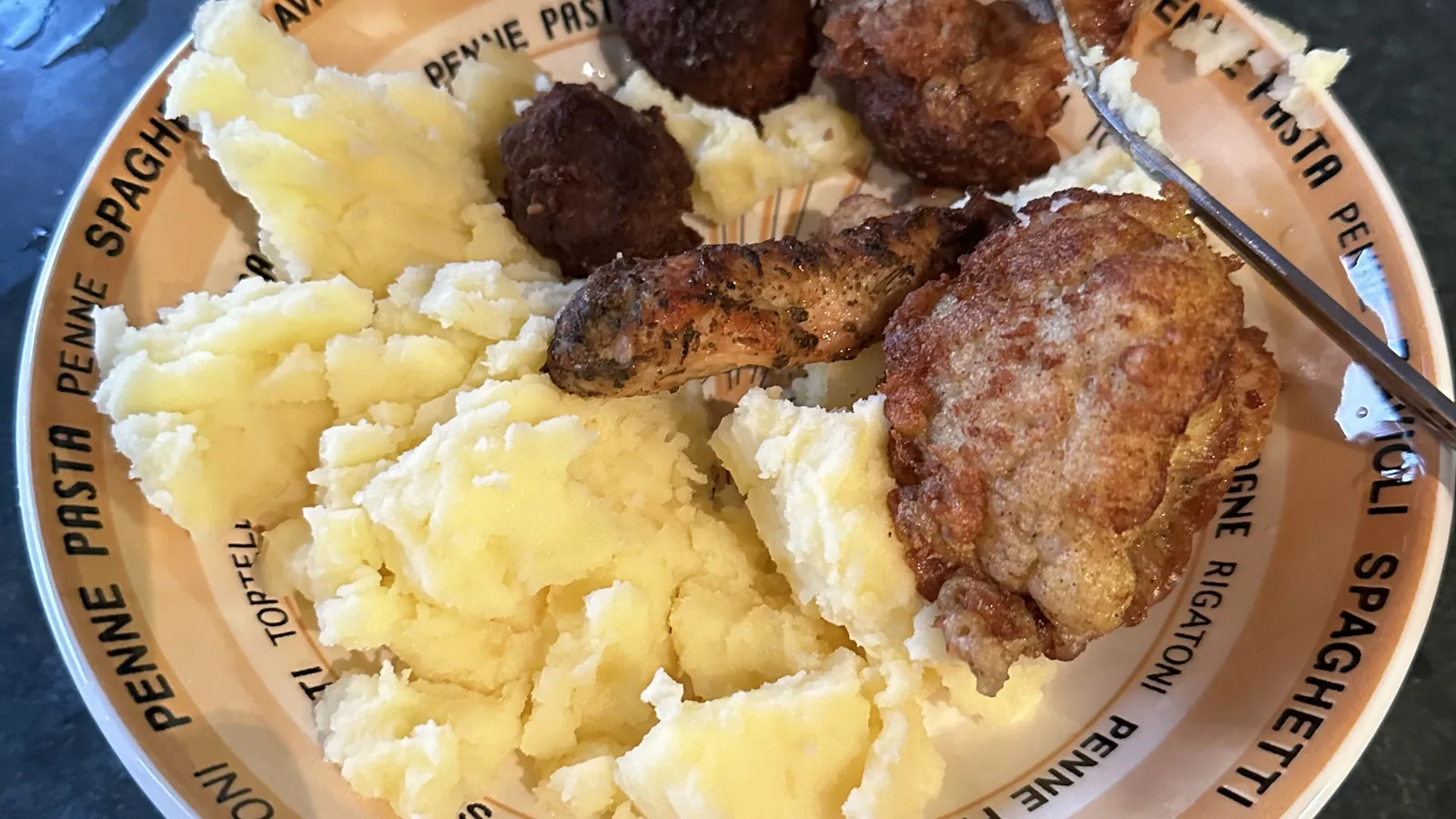
I count my carbs every day. Not to cut them, but to make sure I eat enough of them. That's where my strength comes from. With enough carbs in me I feel like I could push a truck. And still, every year someone online tells me carbs are the enemy.
So why does the fitness world keep selling the same myths? Here's how I see it. Not a conspiracy, just business.
Cheap food doesn't make anyone rich
Nobody gets rich selling you a bag of potatoes, oats or rice. A tub of powder, a "fat burner", a special low-carb bar or a 12-week meal plan is a different story. So the message is always some version of: normal food from the supermarket is not enough, you need this.
Some products are fine. I take creatine and magnesium myself (I wrote about what creatine actually does). But a product should solve a real problem, not one somebody invented to sell it.
Water loss looks like a miracle
Cut carbs hard and the scale drops 1–3 kg in a few days. People think: it works! Most of that is not fat. Your muscles store carbs as glycogen, and glycogen holds water. In one study, muscle stored about 3 grams of water for every gram of glycogen. Empty the glycogen, the water goes with it.
That's not nothing, but it's not fat loss either. And it comes back the first time you eat a plate of pasta, which makes people think carbs made them fat overnight. I explained the overnight scale jumps here.
What does the long-term research say? In a big one-year trial (DIETFITS, over 600 adults), a healthy low-fat diet and a healthy low-carb diet ended up with basically the same weight loss. And in a tightly controlled metabolic ward study, cutting fat removed slightly more body fat than cutting the same number of calories from carbs. The enemy is not a macronutrient. It's eating more than you burn, for years.
You can't sell "eat normally, train hard, sleep, repeat"
The honest message is boring: eat real food, enough protein, train hard with progressive overload, sleep 7–8 hours, and do it for years. Nobody can sell that in a 30-second video.
So they find an enemy (fat in the 90s, carbs from the 2010s) and a secret that only they can sell you. Every few years the enemy changes, because if everyone believed the boring basics, there would be nothing new to sell.
The bodies you compare yourself to
A lot of the bodies on magazine covers and social media are not natural. That's not a secret in the industry, it's just not said out loud. Drugs change the rules: what works for an enhanced athlete on a very low-carb diet doesn't tell you much about what works for you.
I'm lifetime natural. For me, cutting carbs hard means weaker sessions, flatter muscles and slower recovery. Research on high-intensity training points the same way: very low-carb diets tend to hurt hard, repeated efforts, which is exactly what lifting and sprinting are.
Even protein gets oversold
I count protein too, so I'm not against it. But more is not always better. A large review of resistance-training studies found that the extra muscle gain levels off at around 1.6 g of protein per kilo of body weight per day, with some people benefiting from a bit more. You don't need a shake every two hours. You need enough protein spread over your meals, like this.
What I actually eat
Nothing fancy. In the morning, protein and carbs. Lunch is a proper meal, heavy on carbs, with the protein there too. In the evening, carbs and protein again. On top of that: avocado, yogurt and milk. I buy good-quality yogurt when it's on offer, and I love milk. I buy the blue-cap one, which isn't too fatty. The label says 3.5 g of protein per 100 ml, so a litre gives you 35 g of protein for €1.29. The bottled "protein" drinks and yogurts next to it give you 25 g for €1.89–2. If I need protein, I drink milk.
Potatoes: I buy them in 5 kg bags for about €4. That counts as expensive here in the Netherlands, and it's still cheaper per meal than any protein bar. If I could only eat one food for the rest of my life, it would be potatoes. No question.
Bread is where I'm picky. Not the soft, sweet toast bread. I want the kind they used to bake in a wood oven: Serbian bread, or proper Hungarian bread. Heavy, with a crust. That's real food.
What actually builds strength
Old-school strength and real muscle were always built the same way: hard, progressive training and plenty of simple food. Meat, eggs, potatoes, rice, oats, fruit, vegetables. Not a cupboard full of boxes.
If you want to see the numbers instead of guessing, the free FitFat app works out your calories, protein and carbs from your body and your goal, and the training programs give you the hard work part.
Sources
- Gardner CD et al. Effect of low-fat vs low-carbohydrate diet on 12-month weight loss (DIETFITS). JAMA, 2018. doi:10.1001/jama.2018.0245
- Hall KD et al. Calorie for calorie, dietary fat restriction results in more body fat loss than carbohydrate restriction in people with obesity. Cell Metabolism, 2015. doi:10.1016/j.cmet.2015.07.021
- Fernández-Elías VE et al. Relationship between muscle water and glycogen recovery after prolonged exercise in the heat in humans. European Journal of Applied Physiology, 2015. doi:10.1007/s00421-015-3175-z
- Morton RW et al. A systematic review, meta-analysis and meta-regression of the effect of protein supplementation on resistance training-induced gains in muscle mass and strength. British Journal of Sports Medicine, 2018. doi:10.1136/bjsports-2017-097608

I run FitFat AI and I train because I want to still be running when I am old, not shuffling. Lifetime natural. I am not a doctor or a dietitian, so I link my sources and tell you when something needs a professional.
More about me