Protein advice after 50 usually begins with a number and ends with a tub of powder. That skips the difficult part: turning a daily target into meals a person actually wants to eat.
Protein supports muscle and many other tissues, but it does not work alone. Resistance exercise supplies the training signal. Sufficient food supplies energy. Sleep and consistency help you repeat the process. More protein cannot rescue a programme with no progressive movement, and a single enormous dinner does not make a weak breakfast disappear.
The FitFat AI Protein Anchor Method starts with meal structure, not supplements.
The guidance—and its limits
The standard adult protein reference is commonly expressed as 0.8 grams per kilogram of body weight per day. Specialist guidance for older adults often goes higher. ESPEN's practical guideline says older people should receive at least 1.0 g/kg/day, adjusted for nutritional status, activity, disease and tolerance; it notes that 1.0–1.2 g/kg/day has been suggested for healthy older adults.
That is a population-oriented range, not a personalised prescription. Body weight can be a poor calculator in people with substantial fluid retention, very high or low body weight, acute illness or changing kidney function. Illness, wounds and malnutrition may increase needs, while some kidney conditions require individual planning. A clinician or dietitian should set the target when health conditions materially affect protein handling or appetite.
Step 1: find the missing meal
Do not begin by counting every gram for a week. Look at yesterday and ask one question: Which main meal had no obvious protein anchor?
Common patterns are toast and jam at breakfast, soup alone at lunch, then nearly all the day's protein at dinner. The first improvement is not to enlarge dinner. It is to repair the emptiest meal.
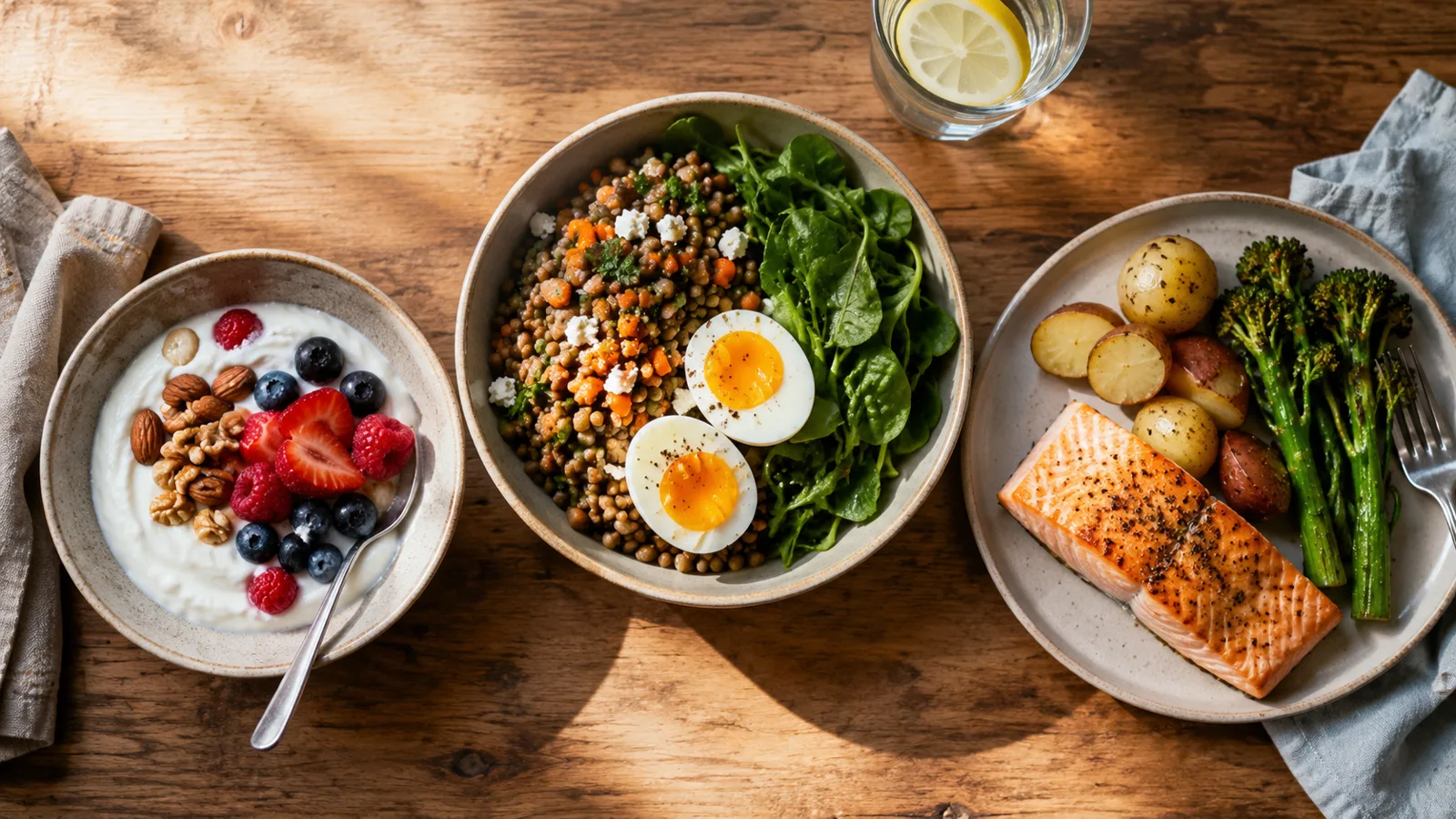
An anchor is a recognisable protein-rich food that would still be visible if the plate were photographed from above: yogurt, eggs, fish, poultry, tofu, tempeh, beans, lentils, cottage cheese or a deliberate combination.
Step 2: build three anchors
Use three flexible meal templates.
The quiet breakfast anchor
Breakfast does not need to become steak and eggs. Options include:
- Greek-style yogurt or skyr with oats, nuts and berries;
- two eggs with whole-grain toast and beans;
- porridge made with milk or fortified soy drink, plus yogurt on the side;
- tofu scramble with vegetables and toast.
The practical test is whether breakfast contains a meaningful protein food, not whether the packaging advertises “high protein.”
The assembled lunch anchor
Lunch often fails because it is improvised. Use a one-plus-one pattern: one main anchor plus one supporting source.
- lentils plus egg;
- bean soup plus yogurt;
- tuna plus whole-grain bread;
- tofu plus edamame;
- cottage cheese plus seeds and rye crackers.
This pattern is especially useful for plant-based meals, where combining a substantial legume or soy portion with another food can make the meal more robust without obsessing over amino-acid charts.
The familiar dinner anchor
Keep the usual dinner, but give the anchor a defined place rather than letting it crowd out vegetables, whole grains or potatoes. Salmon, chicken, tofu, tempeh, beans or lentils can all work. The rest of the plate still matters for fibre, micronutrients and enjoyment.
Step 3: use the handoff test
At the end of the day, each meal should hand off part of the job to the next one. If breakfast and lunch contain clear anchors, dinner no longer has to carry the entire total.
This distribution principle is practical rather than magical. Research has not established one perfect number of grams at exactly timed intervals for every older adult. The useful conclusion is more modest: regularly leaving one or two meals almost protein-free makes it harder to achieve a reasonable total and gives muscle fewer feeding opportunities.
A no-calculator audit
For three days, mark each main meal:
- 0 — absent: no clear protein food;
- 1 — supporting: some protein, but mainly incidental;
- 2 — anchored: a deliberate, substantial source.
A daily pattern of 2–2–2 is more useful than achieving a mathematically perfect day followed by two chaotic ones. If you repeatedly score zero at one meal, fix that meal first.
When a supplement may—or may not—help
A simple protein powder can be convenient when appetite, chewing, travel or schedule makes food difficult. It is not automatically superior to food, and multi-ingredient “muscle” blends add uncertainty. NIH notes that combinations in performance supplements are often less well studied than individual ingredients and amounts can vary widely.
Before buying powder, ask:
- Is there a genuine gap, or just marketing pressure?
- Could yogurt, milk, soy drink, eggs, tofu or leftovers fill it?
- Does the product add ingredients you did not ask for?
- Do kidney disease, medication or swallowing problems make professional advice sensible?
Protein does not earn unlimited status
Higher-protein eating can become lower-quality eating if it pushes out fibre-rich plants, encourages excessive processed meat, or turns every snack into a fortified product. The goal is not maximum protein. It is adequate protein inside an overall pattern that supports health.
Pair the method with strength work at least twice weekly if appropriate. Muscle is maintained by the partnership between load and nutrition, not by one nutrient acting alone.
A seven-day starting experiment
For one week:
- Keep dinner unchanged.
- Add one breakfast anchor on four days.
- Add one assembled lunch anchor on four days.
- Record energy, fullness, appetite and practicality—not just grams.
- Keep only the combinations you would willingly repeat.
That creates a personal shortlist without pretending to be a personalised medical plan.
Sources
- ESPEN Practical Guideline: Clinical Nutrition and Hydration in Geriatrics
- Clinical Nutrition: ESPEN Guideline Full Text
- NIH ODS: Dietary Supplements for Exercise and Athletic Performance
- CDC: Physical Activity Guidelines for Older Adults
Review note: People with kidney disease, acute illness, unintentional weight loss or prescribed dietary restrictions should use individual professional guidance. Reviewed August 24, 2026.
Reviewed under our editorial policy. Please also read our medical disclaimer.