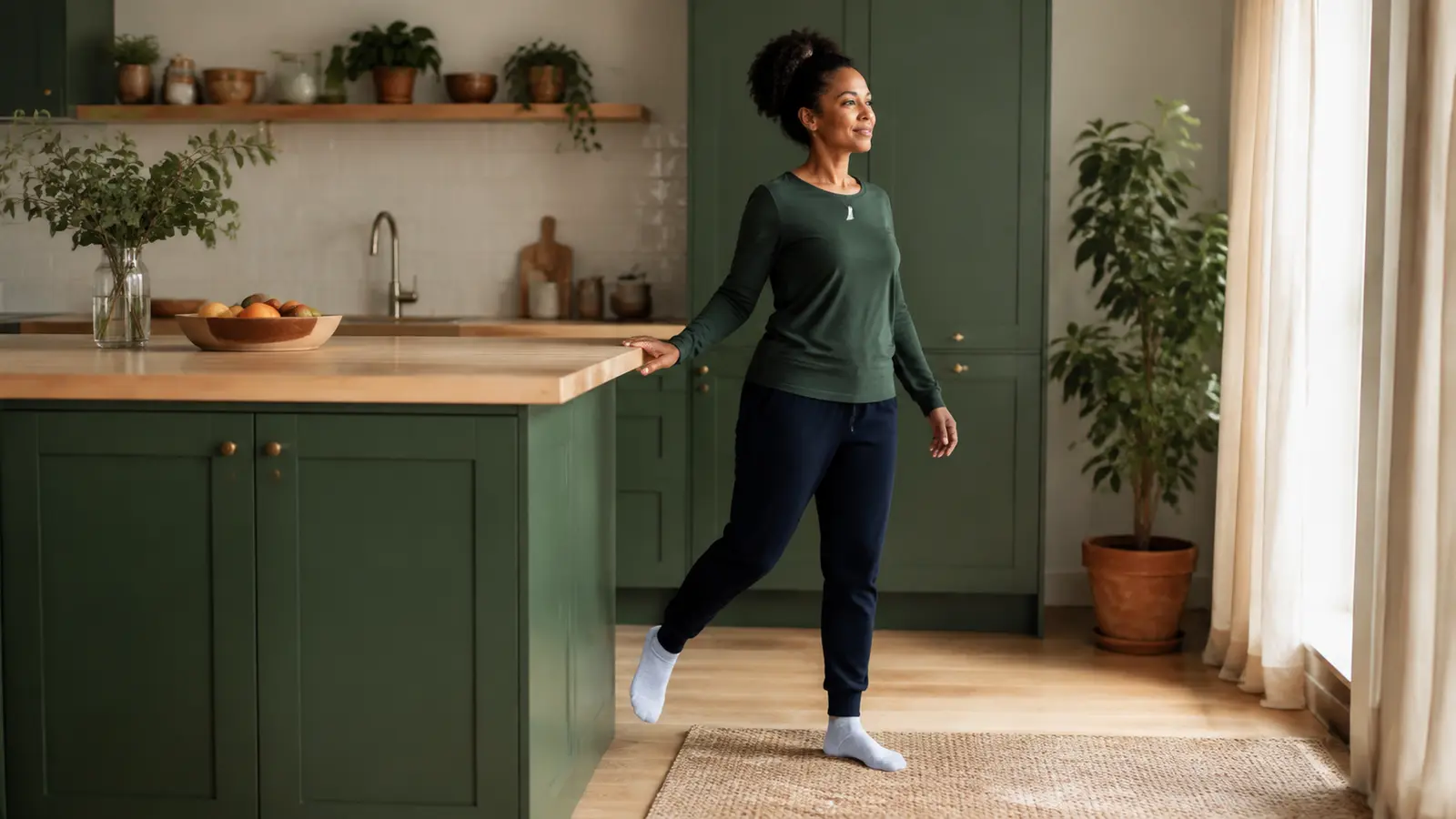
Balance is a skill, and skills improve with frequent, sensible practice. The goal is controlled challenge beside a stable support—not wobbling as dramatically as possible.
Balance also depends on vision, the inner ear, sensation, strength, medication effects and the nervous system. A short routine can provide practice, but it cannot identify why a person feels unsteady or replace a fall-risk assessment.
Set up safely
Practice near a kitchen counter or another support that will not move. Wear secure footwear, remove loose rugs and keep pets out of the practice area. If you fall frequently or feel dizzy, seek professional guidance first.
Do not practice alone when you cannot reliably recover with the available support. A wheeled chair, lightweight table or towel rail is not a stable handhold.
Try four supported drills
Work for about thirty seconds per exercise and repeat once if you feel steady.
- Narrow stance: feet close together, fingertips on the counter.
- Tandem stance: one foot partly in front of the other.
- Weight shifts: slowly move weight from one leg to the other.
- Marching: lift one foot at a time while standing tall.
The timing is an editorial starting framework, not a clinical dose. Use a wider stance or more hand support when needed. The correct level creates mild, controllable challenge without a step, grab or near-fall.
Make it harder carefully
Reduce hand support before narrowing your stance further. Never close your eyes unless a qualified professional has assessed that progression. Stop if you feel faint, experience new numbness or cannot recover your balance easily.
Change only one element at a time: hand support, stance, duration, head movement or surface. Combining several progressions makes the task less predictable and can add risk without demonstrating better training.
When a five-minute routine is not the answer
New or worsening unsteadiness, fainting, vertigo, one-sided weakness, new numbness, a recent head injury or repeated falls warrants appropriate assessment. Sudden neurological symptoms can be an emergency. Follow local emergency guidance rather than testing another drill.
For older adults at fall risk, effective prevention may include strength and balance exercise, medication review, vision and foot assessment, and home changes. One exercise list is not a complete fall-prevention program.
Claims we reject during editing
- “Standing on one leg proves your biological age.” One task cannot establish that.
- “Closing your eyes makes every drill better.” Removing vision can sharply increase difficulty and risk.
- “Poor balance always means weak muscles.” Multiple systems contribute.
- “Five minutes prevents falls.” A brief routine is practice, not a guaranteed outcome.
- “More wobbling means more progress.” Controlled recovery matters more than spectacle.
This article is general adult education and not rehabilitation or a neurological, vestibular or fall-risk assessment.
Sources checked by our editors
- WHO: Guidelines on physical activity and sedentary behaviour
- CDC STEADI: Patient and Caregiver Resources
- CDC: Compendium of Effective Fall Interventions
Review note: Last checked August 24, 2026. The supported drills are a conservative editorial example, not a validated standalone fall-prevention program.
Reviewed under our editorial policy. Please also read our medical disclaimer.