People with knee osteoarthritis often receive two contradictory messages: “Never push through pain” and “exercise is medicine.” Taken literally, the first can make movement impossible and the second can make every symptom feel like a personal failure.
The useful middle ground is tailored therapeutic exercise. NICE recommends exercise for people with osteoarthritis, including local muscle strengthening and general aerobic fitness. It also says pain may initially increase, while regular adherence can improve pain, function and quality of life.
That does not mean every painful repetition is good. It means symptoms need context.
The FitFat AI Joint Traffic Light is a decision framework for ordinary sessions. It is not a diagnostic tool or a substitute for a physiotherapy plan.
Before the colours: establish your normal
Record three things before exercise:
- your usual pain or stiffness at this time of day;
- whether the knee is more swollen, hot or unstable than usual;
- what you could comfortably do during the previous session.
The traffic light compares today with your own baseline. A number such as “3 out of 10” means little without knowing whether it is familiar, rising or accompanied by loss of function.
Green: familiar and settling
Green does not mean completely symptom-free. It means:
- discomfort is mild or familiar;
- movement remains controlled;
- you are not limping more as the set continues;
- symptoms settle when the exercise stops;
- the knee is not meaningfully worse later that day or the next morning.
In green, continue the planned dose. Progress only one variable: one or two repetitions, a slightly lower chair, a small weight increase or an extra walking interval.
Amber: modify and learn
Amber includes discomfort that is clearly higher than normal, stiffness that changes technique, a new mild limp, or symptoms that remain elevated longer than expected after the session.
Do not automatically abandon the week. Modify one lever:
- reduce the range of motion;
- use a higher chair;
- use hand support;
- reduce load or repetitions;
- replace continuous walking with shorter intervals;
- allow an additional recovery day.
Then observe the next 24 hours. Amber is information. If the modified dose settles well, it may become the current working level. If amber repeats or worsens, professional review is sensible.
Red: stop and seek appropriate help
Red includes a hot, markedly swollen joint; a knee that locks or repeatedly gives way; inability to bear weight; substantial trauma; calf swelling; fever; severe night pain unlike your usual pattern; or sudden major loss of function.
Those features are not a cue to “strengthen through it.” Stop and seek timely medical assessment. Emergency symptoms require urgent services.
A three-movement starter session
This example is deliberately conservative and assumes the movements are already appropriate for you.
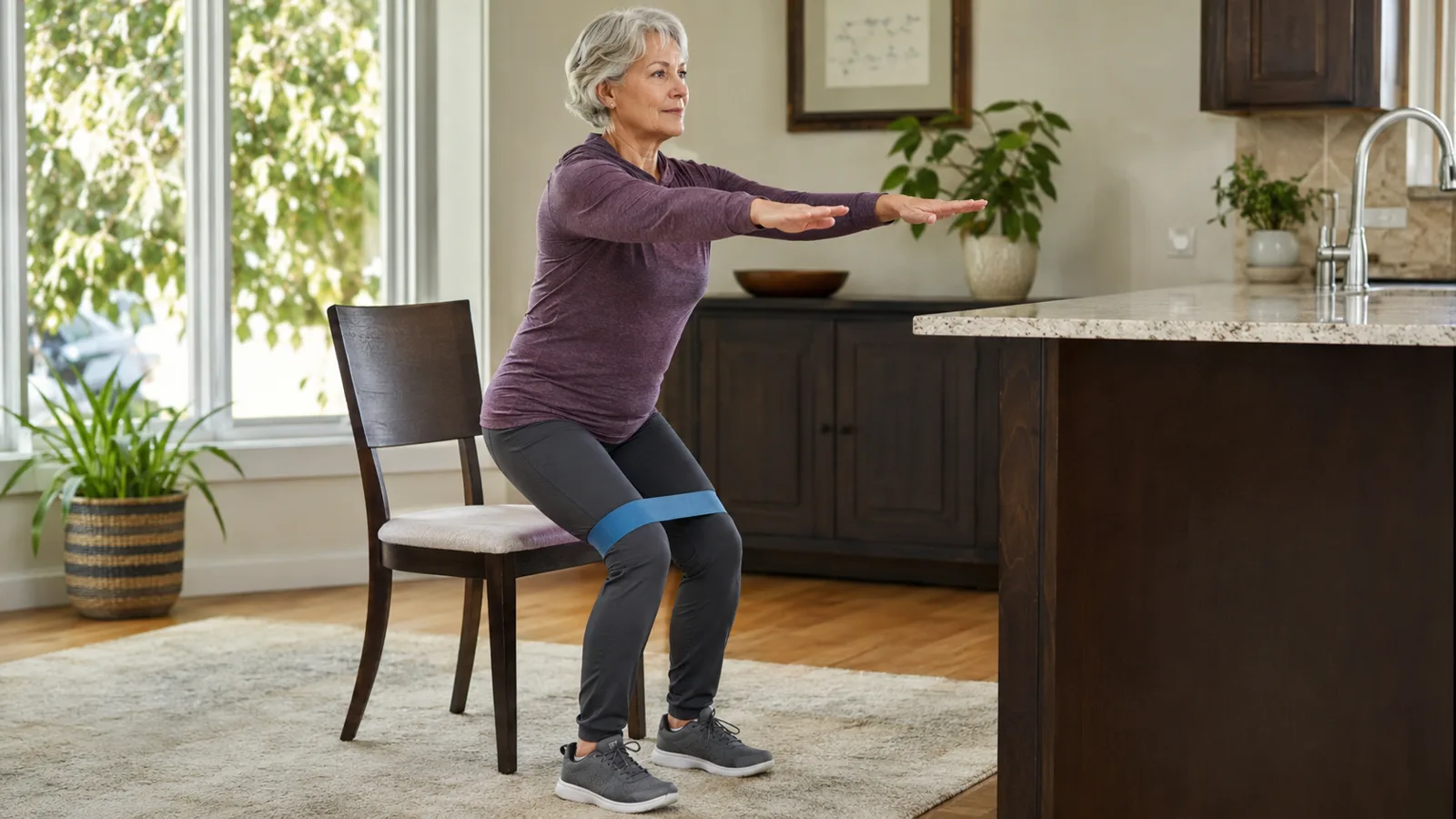
1. Supported chair rise
Use a firm chair. Lean slightly forward, push through both feet and use the armrests or countertop as needed. Perform one set of five controlled repetitions.
Adjust by changing chair height before adding weight. A higher chair reduces knee demand and can preserve a clean movement pattern.
2. Low step-up or weight shift
Hold a rail or countertop. Use the lowest practical step and perform four slow repetitions per side. If step-ups are amber, practise shifting weight onto one foot while keeping the other toes on the floor.
3. Short walking intervals
Walk for two to five comfortable minutes, rest briefly, then repeat. Intervals can produce a useful total without requiring one uninterrupted bout.
Finish while movement still looks like the first repetition. More is not always more therapeutic.
The next-morning rule
The session is not fully scored when it ends. Check the next morning:
- Is stiffness close to normal after moving around?
- Is swelling unchanged?
- Can you use stairs or rise from a chair at your usual level?
- Has your confidence improved, stayed stable or fallen?
If symptoms are meaningfully worse, reduce the next dose rather than compensating with complete inactivity or another hard session.
There is no universal number of acceptable pain points or recovery hours. Research and clinical programmes use different monitoring rules, and individual context matters. The baseline comparison is intentionally cautious.
Exercise is broader than the knee
Hip strength, calf capacity, balance, sleep, body weight where relevant, fear of movement and the demands of daily life can all influence knee function. NICE identifies exercise and, where appropriate, weight management as core treatments. It does not present exercise as punishment for body size.
Manual therapy, braces or passive treatments should not displace an active plan when exercise is appropriate. Likewise, exercise should not become a reason to delay assessment of red-flag changes.
Build consistency before intensity
For two weeks, repeat the same small session twice weekly and use the traffic-light notes. The first goal is to discover a repeatable dose. Once you have two green weeks, change one lever.
This creates something generic advice cannot provide: a record of your response to a defined session. The result is still not a diagnosis, but it is much more useful than guessing whether one painful day means “stop forever” or “push harder.”
Sources
- NICE: Osteoarthritis in Over 16s—Diagnosis and Management
- NICE Quality Standard: Therapeutic Exercise
- NCBI Bookshelf: NICE Osteoarthritis Guideline
- CDC: Physical Activity for Arthritis
Review note: This framework provides general education, not a diagnosis or individual exercise prescription. Reviewed August 24, 2026.
Reviewed under our editorial policy. Please also read our medical disclaimer.