Search for a beginner strength plan and you will quickly meet two extremes: routines so complicated that they need a spreadsheet, and promises that a few minutes will transform your body. Neither is a useful starting point.
Resistance training means making muscles work against an external resistance. That resistance can come from a machine, free weight, band or body weight. The purpose is not automatically bodybuilding. Adults may train for strength, physical function, sport, muscle growth or simply to make everyday tasks easier.
This article explains what current guidance supports, what remains individual, and how a healthy adult beginner might organize two simple sessions. It is not a personalized prescription or rehabilitation program.
What the official guidance actually says
The U.S. Physical Activity Guidelines recommend muscle-strengthening activity involving all major muscle groups on two or more days each week. This is a population-level target, not a requirement to perform every possible exercise or train to exhaustion.
In 2026, the American College of Sports Medicine published an updated position stand based on an overview of reviews covering resistance-training outcomes in healthy adults. One of its central practical messages is that many forms of resistance training can work and that the program should match the desired outcome. The variables used to maximize strength are not identical to those used to maximize muscle growth.
That nuance is easily lost online. A beginner seeking general strength does not automatically need a bodybuilding volume target, advanced percentage calculations or a one-repetition maximum test.
Begin with movement categories, not a giant exercise list
A simple full-body session can cover several useful patterns:
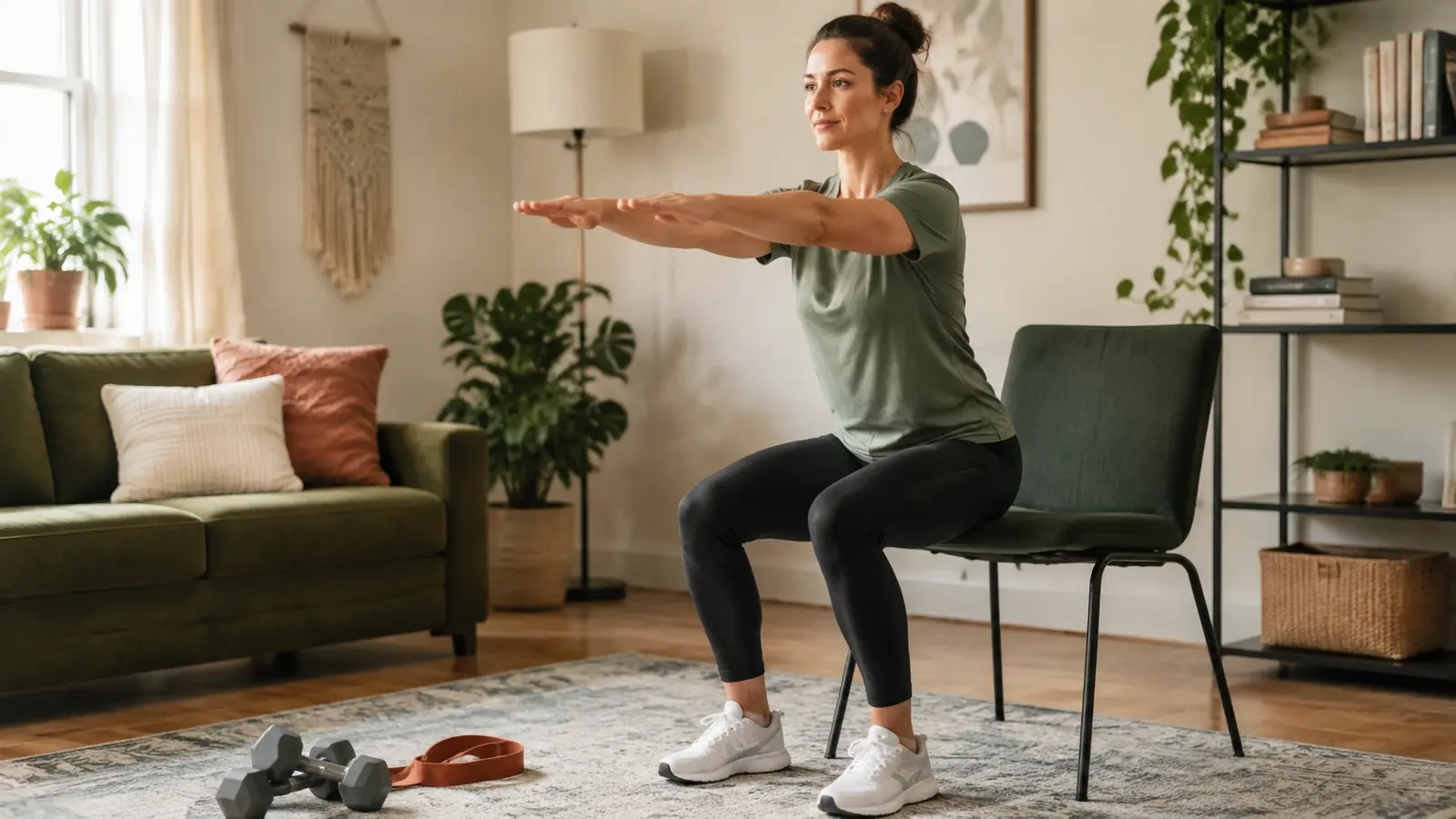
- a squat pattern, such as a controlled chair sit-to-stand;
- a push, such as a wall or elevated push-up;
- a pull, such as a supported resistance-band row;
- a hip-dominant movement taught at an appropriate level;
- a carry or trunk-stability task, when suitable.
These are categories, not mandatory exercises. Equipment, disability, pain history, balance and training environment can all change the appropriate selection.
The FitFat AI two-day starter framework
The following is our conservative editorial framework for otherwise healthy adult beginners. It has not been presented as a clinically tested protocol.
| Session | Exercise selection | Starting work | Effort |
|---|---|---|---|
| Day A | 4–5 movements covering the body | 1 set each | Finish with several controlled repetitions still possible |
| Day B | Repeat or use close alternatives | 1 set each | Similar controlled effort |
Place at least one recovery day between the sessions. Begin with a resistance that allows steady technique through a comfortable range. Six to twelve repetitions may be a practical observation range for many exercises, but a fixed repetition target is not appropriate for every person or every movement.
The goal of the first two weeks is to learn the exercises and observe recovery—not to discover the maximum weight you can lift.
Progress one variable at a time
When both weekly sessions feel controlled and recovery is acceptable, choose one small change:
- add one or two repetitions within the planned range;
- increase the resistance by the smallest practical amount; or
- add a second set to one or two movements.
Do not change all three at once. Logging the exercise, resistance, repetitions and any symptoms is more informative than chasing soreness.
Training to momentary muscular failure is not a requirement for a beginner session. The 2026 ACSM material emphasizes tailoring resistance training to the outcome; it does not turn the hardest possible effort into a universal rule.
What counts as evidence of progress?
Progress may appear as more than a larger weight:
- the same repetitions feel more controlled;
- you use a slightly greater range without symptoms;
- an everyday task feels easier;
- you complete another repetition with comparable technique;
- you recover more predictably between sessions.
A dramatic transformation photo is not a reliable measurement method. Lighting, posing and selection can change the image without demonstrating strength or health.
Safety is specific, not ceremonial
- Use stable equipment and an uncluttered training area.
- Learn how to adjust or safely release any equipment before loading it.
- Avoid deliberately holding your breath unless a qualified professional has taught you an appropriate technique for your context.
- Stop for sharp or escalating pain, chest pressure, faintness or severe unusual breathlessness.
- Do not copy an exercise around a recent operation, acute injury or unexplained symptom simply because it appears in a general article.
Urgent symptoms require urgent medical attention. People with chronic conditions, pregnancy-related considerations, significant balance limitations, a recent procedure or an injury may need guidance from an appropriate clinician or qualified exercise professional.
Claims we would reject during editing
- “Muscle turns into fat when you stop.” These are different tissues.
- “Women become bulky by accident.” This is a marketing stereotype, not useful programming guidance.
- “Soreness proves the workout worked.” Soreness is not a required outcome.
- “Everyone must lift heavy.” Load should reflect goals, experience and individual safety.
- “One perfect exercise trains everything.” No single movement satisfies every goal and limitation.
- “Strength training replaces aerobic activity.” Official guidance includes both muscle strengthening and aerobic activity.
A simple first-session checklist
Before starting, confirm that you know:
- which four or five movements you will perform;
- how the equipment works;
- what controlled technique looks like for you;
- when the set ends;
- which symptoms mean you should stop;
- when the next recovery day occurs.
A routine that is understandable, repeatable and gradually adjustable is a stronger beginning than an “optimal” plan a person cannot perform consistently.
This article provides general education for adults and does not provide individual medical clearance, diagnosis or treatment.
Sources checked by our editors
- American College of Sports Medicine: 2026 resistance-training guideline update
- ACSM: Updated position stand on resistance training
- U.S. Physical Activity Guidelines for Americans, 2nd edition
- WHO: Physical activity fact sheet
Review note: Last checked August 24, 2026. The ACSM position stand concerns healthy adults and outcome-specific programming. Our starter framework is intentionally conservative and should not be interpreted as an ACSM-prescribed universal routine.
Reviewed under our editorial policy. Please also read our medical disclaimer.